
Ghosted Again? Pastors Respond to Disappearing Congregants

Church leaders are seeking fresh ways to prevent "backdoor exits" and adapt to shifting membership.

---

by Maria Baer

---

The membership packet for new congregants at Cross City Church in Columbus, Ohio, is pretty straightforward. There’s a section enumerating the church’s “essential doctrines,” including creedal beliefs like the Trinity and the saving work of Jesus on the cross. There’s a section about church leadership and discipline, explaining the church’s process when a member sins.

And there’s a curious section under membership, “How to Be Sent Out or Leave the Church”:

There are many ways in which God calls His children out of one spiritual family into another. Physical moving, leading to a new mission and disagreement are all ways in which He moves His children. All these may happen without sin and with a full and righteous leading of the Spirit. … We pray and ask the members of Cross City to be prayerful, honest and communicate concerns, offenses, hopes, ideas and convictions in an early fashion, rather than allowing them to fester in isolation and cause division, hurt, or other ungodly effects within God’s family.

Cross City is part of the Evangelical Free Church of America, but church leadership came up with the idea for this section themselves.

Despite having a written policy against ghosting, pastor Scott Burns said the majority of people who’ve left over the church’s 11-year history departed without notice. “They just get quiet,” he said. “And one week turns into four, which turns into six.”

Pandemic shifts, along with rising political and social divisions, have made ghosting a major problem for pastors across the country. Across demographics, US adults are less likely to attend church than they were two years ago, according to the American Family Survey. While some slowly came back from shutdowns and pandemic restrictions, Pew Research Center reported in March 2022 that the return to church had plateaued. Odds are, if they were coming back, they’d be back by now.

Even before the pandemic, church membership wasn’t stagnant, and pastors knew not to take it personally when congregants left. The natural bends and twists of life—relocations, college attendance, job changes, deaths—mean all church bodies turn over with time. Yet the quiet, unexpected departures leave a lingering sting. With all the recent upheaval, it’s a feeling that’s become harder to ignore.

At Concord Church in Dallas, pastor Bryan Carter said attendance at Sunday gatherings is only about 65 percent of what it used to be, while online gatherings have grown by 400 percent. It’s hard to know who left for good, who moved online, and who joined.

Two years into the pandemic, pastors like Burns and Carter are eager to create a church culture that discourages ghosting in the first place.

---

A time to seek and a time to lose

---

Ghosting is dating parlance. It means to go radio silent in the middle of a budding online romance. In that world, to reach out to a “ghost” is bad form—it’s desperate or creepy. So this isn’t the perfect analogy for those who leave a church body with no word.

When members or regular attendees leave a church without explanation, pastors have a few choices, but all come with sensitivities. If you ignore departures, you risk overlooking potential problems in the church that prompted people to leave.

If you reach out to follow up with leaving congregants, you risk exacerbating hurt feelings on both sides. Even asking questions could put pressure on the former members, implying leaders are angry or against them.

Many pastors are burdened to reach out to leavers, whether to make sure the church didn’t cause harm or to extend a shepherd’s crook to the wayward, just as the shepherd in Jesus’ parable of the lost sheep in Matthew 18 left his 99 to seek the one that “wandered off.”

Darryl DelHousaye is chancellor of Phoenix Seminary and was a longtime pastor at Scottsdale Bible Church, a 7,500-person congregation. He doesn’t remember learning about how to deal with “ghosters” in seminary; nor does Phoenix Seminary cover it in any official curriculum. He called that a potential blind spot.

DelHousaye said his protocol at Scottsdale Bible was to reach out to families who ghosted. “I would call them and say … ‘Where are you guys worshiping?’” Most people were shocked to hear from him “but grateful,” he said.

For pastors of megachurches, reaching out to ghosters might sometimes mean contacting people they’ve never really gotten to know. At Concord Church, Carter said he hasn’t fully implemented a good system to address what he calls the church’s “backdoor” exits. Part of his challenge as the pastor of a 2,500-attender church is recognizing when someone leaves.

“We have two indicators for Sunday attendance: giving and childcare,” he said. The church tracks both, which should make it easier to notice a sudden absence. But the huge popularity of their online services during COVID-19 has made it more difficult to know whether someone has stopped attending altogether or is just attending virtually.

It’s harder to leave unnoticed at smaller congregations, but people still exit without explanation.

Paul Risler is the pastor of Central Avenue United Methodist Church in Athens, Ohio. It’s a rural church with about 200 members. For Risler, reaching out to someone who has ghosted means touching base with someone he almost definitely knows and whose absence can’t go unnoticed among the congregation.

“I used to be more intimidated by those conversations,” Risler said. But he can’t avoid them. Leaving Central is baked into the church’s context: It’s located in the middle of Ohio University’s main campus, and around half his congregation is college students.

During the pandemic, Risler noticed the same thing Carter in Dallas did: The online-only services gave members the option to “tour” other churches online.

Risler said the option for college students in particular to virtually attend services elsewhere—including churches shepherded by nationally known pastors—proved too tempting to avoid. Many college students never returned to Central. “We lost our junior and senior class, basically,” Risler said.

When the church identifies departing congregants, Risler said he’s committed to reaching out for “exit interviews.”

“I just want to make sure that the reason they’re leaving isn’t because we harmed them or sinned against them or that there isn’t something we can fix,” he said.

Burns said part of what makes ghosting so deeply hurtful for pastors is that it means those who left secretly—even for understandable reasons like starting a new job or moving away—chose to do it without prayer and guidance from their church family.

“If the people are strong in Jesus and they find our church not a good home to be at … that’s a concern,” he said. “Is that our preaching? Is it the way we lead things? That’s hard.”

Carter said after the pandemic he’d like to implement a protocol of making “care calls” to people who’ve left without word. Instead of trying to stem the tide of ghosters, he’s going further upstream: He wants to create a church culture that discourages ghosting in the first place. “We’ve seen [ghosting] before,” he said. “We think part of it is we weren’t calling people to a higher mission.”

---

A time to break down and a time to build up

---

In an area as transient as Scottsdale, a rapidly growing city where families and young adults move in and away with unique frequency, DelHousaye used the phrase “come, grow, go” to describe the pattern of people inevitably leaving his church.

DelHousaye said when pastors don’t hold their congregants “loosely” enough—when they cling to church growth and demand loyalty from members—they unwittingly encourage ghosting.

“If people are going to be loyal, they tend to be more loyal if they realize they’re there by choice and not by manipulation,” DelHousaye said. “We made it so that you didn’t have to be afraid to tell people you were leaving,” he said of his “come, grow, go” philosophy. In fact, he said when he heard of a new church plant coming to town, as long as he believed it was “biblically solid,” he’d ask the planting pastor to share his vision from the pulpit and invite people to join him.

Burns in Columbus is trying to create a similar culture in his small Ohio congregation. “You should be able to trust that the church is not desperate to have you,” he said. “Otherwise, you shouldn’t be going to that church.”

The key for each pastor to create such a culture, DelHousaye said, is remembering whose church it is—not the pastor’s.

“If Jesus wrote a letter, it wouldn’t be to Scottsdale Bible Church,” he said. “It would be the letter to Arizona, to Utah, to Galatia, to Ephesus … It’s the church of Jesus Christ. It’s not my church.”

Carter in Dallas said his strategy to prevent ghosting is to encourage deep connection: “Here’s the deal. If somebody is worshiping, if they’re giving, if they’re serving, if they’re in a small group, the likelihood of their ghosting is low.”

Carter’s goal is to train 300 new small-group leaders this year. That includes leaders for online small groups, which meet virtually and are part of his strategy to prevent even digital ghosting. He wants to communicate that “going” to church online or even just sitting in the pews each Sunday isn’t enough. “We’re trying to say your commitment to Christ is not fulfilled until you’re helping other people grow in their journey with him,” he said.

Risler at Central has come to the same conclusion. He said pastoring a church body of mostly mobile college students has forced him to get creative about getting people connected and serving in the church quickly. Even official church membership is not a major focus at Central.

“We try to get people ‘onboarded’ pretty quickly,” he said. “So people are serving … and then kind of at the end is our membership commitment.” The idea is that connection breeds investment, which makes leaving without a trace harder.

---

For everything a season

---

Every year, Risler shares what he calls the Post-it story with his congregation. Early in his tenure, he and his team were doing a “SWOT analysis,” an organizational tactic that explores a team’s strengths, weaknesses, opportunities, and threats.

Risler wrote “transience” on a Post-it, intending to stick it in the Weakness column. His children’s ministry pastor misunderstood and placed it under Strength. They had a back-and-forth, but she won him over.

“We’ve been given this opportunity to give people Christ, to have them experience biblical community,” he said. “We’re given this short period of time, and we don’t know how long that’s going to be. So we really have learned to try to maximize that opportunity as much as we can.”

Risler said that’s Central’s reality. It’s also, it turns out, the story of the church.

---

Maria Baer is a CT contributing writer based in Columbus, Ohio.

Link: https://www.christianitytoday.com/.../ghosting-church...

3 Steps to Becoming a Better Servant-Leader

The heart behind leadership is serving others. It’s never about the title, it’s about the towel:

“For even the Son of Man did not come to be served, but to serve,
and to
give His life a ransom for many.”

(Jesus in Mark 10:45)

For what it’s worth, here are 3 steps I’ve discovered toward becoming a better servant-leader.

  1. Choose Trust

Believe the best about others, rather than assuming the worst. When in doubt, lead with the most generous explanation for someone’s behavior.

“Love never stops believing the best about others.” (1 Corinthians 13:7, TPT)

2. Stay Curious Longer

Everyone you meet in life has expertise. Some of the best mentors and friends are known as much by the quality of their questions as the answers they give. Don’t be interesting, be interested.

“Do you not understand these things?” (Jesus in John 3:10)

3. Take the Low Place

Push others into the spotlight. Ask how you can serve others, rather than seeking to be served.

“For the Son of Man came to find and restore the lost.” (Jesus in Luke 19:10, MSG)

Recognizing the Dreaded Signs of Church Splits & Why They Happen

Nobody enjoys a car wreck, but we all inevitably slow down in traffic to peer out the window as we drive by, attempting to ascertain what happened and to (hopefully) learn something that will prevent such a tragedy from happening to us.

With over 20 years of full-time ministry under my belt (plus another 20+ as a pastor's kid), I've seen my share of ugly wrecks in church world. I'm sure you've also heard the stories -- usually whispered around a kitchen table -- of a minor church disagreement erupting into a full-blown church split that affects lives and livelihoods, leaving a black eye on the local Body of Christ.

The stories of church splits are never fun. Real people get hurt. Reputations are slandered. Hurt and heartache can echo for years due to unhealed wounds. And nobody wins: not the church of origin nor the newly formed congregation that results from a church split.

Perhaps by looking at one church split story, we can all learn how to better guard our unity within the church that Christ bled for (Acts 20:28).

This story is my story. You see, during an already-chaotic 2020, I went through a church split as the lead pastor (and founding pastor) of a church I love dearly.

I barely survived the trauma of what one of my counselor's diagnosed as a "mass casualty event" (Yes, I said counselors plural. Even pastors need therapy to ensure they are emotionally-healthy.).

The first thing you should know about church splits is this: at the time of this church split, even though I was the Founding Pastor, I had no idea what was happening behind my back.

My wife and I were not privy to the cruel whispers and private gossip sessions engulfing our staff team and then spilling out into the membership during the COVID lockdowns.

Looking back, I wish there was some sort of ministry alarm that would go off and alert a lead pastor when he is in danger of facing a church split. But, there isn't one. You usually have no idea that a church split is happening under your nose until after it has already occurred and the damage has been done.

My wife and I were completely taken by surprise. We were focused on the primary crisis of navigating COVID lockdowns and frantically fundraising for our staff team. During a crisis when I was putting out fires from COVID, I would look behind me for a bucket of water to be handed up to me... only to realize there was nobody behind me helping.

During this insane season of the COVID crisis now layered with an internal insurrection, I thought and truly believed that a minor misunderstanding at the staff level could be easily resolved with one honest and simple 5 minute conversation (and I still believe that to this day!).

Unfortunately, when you're the lead pastor and staff members try to hijack the church out from under you, behind-the-scenes conversations and condemnations move quickly behind the pastor's back and rumors can spread like wildfire on Facebook.

So, in the interest of helping church leaders who read this blog and sparing you from the immense pain and hurt and betrayal of a church split in the future, allow me to ask and answer the main question: What is the cause of church splits? 

In a word: factions. 

Factions arise when there is a pile-up of disgruntled people who build up a case that becomes a driving fantasy.

Factions are driven by the What If:

  • "What if my assumptions are correct?"

  • "What if the rumors I've heard are true?

  • "What if my pastor - the same guy who led me to Christ and baptized me - what if he is actually a rotten person?"


Factions sadly live their lives on something that has not actually happened.

Factions thrive on anger.  Why anger?

When someone is hurt or experiences pain in their life, the person will often seek to numb the inward pain with outward anger. 

Anger is always secondary to a deeper hurt.  Anger allows the brain to release key hormones that soothe and numb the pain.

When someone is driven by anger, they can become emotionally-flooded.  This makes peaceful resolution difficult.  Perhaps this is why the Apostle Paul wrote:

"Brothers and sisters, if someone is caught in a sin, you who live by the Spirit should restore that person gently." (Galatians 6:1)


When angry people pile-up, you have a faction.  Factions are very manipulative and will often warp facts to fit their narrative.  Because anger arousal is high, it is difficult for the faction to parse facts from fiction.  

This is why the Scriptures warn believers against bitterness:

"See to it that no one falls short of the grace of God and that no bitter root grows up to cause trouble and defile many." (Hebrews 12:15)


When factions form, conflict is inevitable.

The Solution

The solution involves honest, gospel-centered conversation:

"Contrary to our instincts, hard conversations usually don't kill relationships.

They save them.

It's choosing the short, life-saving pain of surgery over the long-term, fatal pain of cancer."
(Josh Howerton)


Galatians 6:1 and Matthew 18:15-17 say to go to our brother.


Ephesians 4:25-27 says to go without delay.

If a faction shuns/ghosts/refuses you, you can still forgive them.

Forgiveness is not a feeling, it is a choice.

You have the rightful choice to untether your heart from their hurt.


"You can forgive even if the person who wronged you is unrepentant.
You can
repent even if the person you've wronged won't forgive you.
But there can be
no reconciliation without repentance from the wrong and forgiveness from the wronged."
(Jared Wilson)

"Make every effort to keep the unity of the Spirit through the bond of peace."
(Ephesians 4:3)


At the church I love, we have decided on
three proactive approaches to head off the forming of any future factions.

For what it's worth,
here is what we have learned from this heartbreaking experience:

1. We will always choose conversation over condemnation.

2. We will always seek to maintain the relationship over trying to win an argument.

3. We will always speak with honesty, not hypocrisy.

And as always, I choose to remain open and ready to meet with anyone, anytime, anywhere with a humble heart and a listening ear.

4 THINGS WE OWE OUR TEAM

We often think about what our team owes us -- what we expect from them.

But there are four things we owe them, as well:

1) GRACE: Not expecting them to be perfect.

2) HONESTY: Shooting straight and being transparent.

3) PROPER PLACEMENT: A place where they can thrive.

4) PRAYER: This opens our hearts to them and provides wisdom and insight to love them.


LEADING THROUGH CHANGE - WHEN STAFF MEMBERS AND CHURCH MEMBERS LEAVE

WHEN STAFF MEMBERS AND CHURCH MEMBERS LEAVE

  1. STAFFING IS A KEY DECISION

  • 1 Timothy 5: “Do not lay hands on a man suddenly.” Any staff hire is a very important, sobering decision. Be slow to hire.

  • You want to hire someone who is focused on the TOWEL, not the TITLE. You are here to SERVE.


2. HAVE A PROCESS IN PLACE FOR EVALUATING STAFF AND KEY VOLUNTEERS

You are giving people significant responsibilities; have a system for evaluating:

  • Character — Not just about morality. Look at their work ethic, faithfulness, integrity.

  • Competency — Are they all hat, no cattle?

  • Culture — Do they fit well within your existing culture?

  • Chemistry — Likeability Factor. Do you enjoy being around this guy?

  • Calling — Look for the fingerprint of God on the hire of that person.

  • Capacity for Leadership — Can they grow with the role and the growth of the church? Can they reproduce themself and become a multiplier, not a maintainer?

3. UNDERSTAND + ACCEPT THAT SOME STAFF + CHURCH MEMBERS WILL HAVE TO TRANSITION

  • Understanding this will save you a lot of heartache.

  • Think of your church like a bus with stops along the way. What happens at a bus stop? Some people get on and some people get off.

  • There will be significant transition points as your church grows.

  • When this happens, remind yourself that this is just all part of the process of church planting.

  • Don’t lose perspective. Your “loss” may actually be a huge win!

  • Some folks need to get off the bus.

  • Why do people leave your church?

  • Sometimes staff will leave you because the responsibilities have grown beyond their capacity to grow with the role.

  • They may outgrow the responsibilities. Your job is to always make sure your staff are being challenged.

  • They may lack the character / competence / chemistry required to stick with it.

  • They may not want to do the spiritual and emotional work in order to grow.

  • Unexpected circumstances arise in life. Think seasons. Life happens in seasons.

4. REMEMBER THAT ALL STAFF AND MEMBERS NEED TO BE HELD LOOSELY.
Anything you hold tightly you suffocate.

5. PROMOTIONS TO KEY LEADERSHIP ROLES SHOULD BE CAREFULLY CONSIDERED THROUGH PRAYER.

  • Faithful in the little before being faithful with much.

  • Make sure they have been tested.

  • This doesn’t always work: people fool you. Potential staff will lie to you to get a job.

  • Be very careful in giving out titles… You can’t take it back.

  • It doesn’t feed your ego, it fits your function.


6. CELEBRATE THE STAYS AND POSITIVELY RELEASE THE GO'S.

  • For some churches the only time the Staff has a party is when someone leaves. When is the last time you had a party with the people who STAY?

  • Sometimes God calls you to go but often God calls you to STAY!

  • Sometimes someone goes and it’s a good thing. Sometimes someone goes and it’s painful. Sometimes people go when they shouldn’t and you can see the truck that’s about to hit them, but they won’t listen to you.


7. BE PREPARED FOR + POSITIVELY PROCESS THE EMOTIONS THAT WILL ACCOMPANY THE EXIT OF PEOPLE.

  • Loss leads to Grief, which can confuse people. Be prepared for the grief. You love the person, you’ve invested in them for years.

  • When you feel grief, don’t beat yourself up about it. Allow yourself to experience and feel.


8. GIVE CLEAR GUIDELINES TO DEPARTING STAFF ON YOUR EXPECTATIONS REGARDING COMMUNICATION.

  • Information Void can crank up a church gossip grapevine: “What’s happening behind the scenes?”

  • This happens when there is too much of time that passes between their decision and the communication.

  • It is foolish to allow departing staff to announce their departure.

  • Provide information to fill any potential void. SOMEBODY is going to tell ‘the story.’ You need to protect the health of your church as it continues moving forward.


9. EXPECT EMOTIONAL RESPONSES TO ANY STAFF MEMBER’S DEPARTURE.

  • Help them process, give them assurance.


10. LEARN LESSONS FROM DEPARTURES THAT CAN MAKE YOU AND YOUR ORGANIZATION BETTER.

  • How can we improve for next time?

  • What can I learn from this?

  • How can this make me better?

11. AVOID PROLONGED DEPARTURES.

  • When someone says they want to leave, let them.

  • Don’t drag it out or they will drag people down with them.

  • When they say they want to leave, their heart has already left.

  • Be generous in their transition.


12. BE APPROPRIATELY GENEROUS TOWARD DEPARTING PEOPLE WHO LEAVE WELL.

  • Err on the side of grace, not pettiness.

  • Oftentimes people who leave will talk badly about you behind your back. Be gracious.


13. EXPECT A HONEYMOON PERIOD ON SOCIAL MEDIA AT THE DEPARTING PERSON’S NEW PLACE.

  • “This new place is amazing!” Which means your place wasn’t.

  • At some point real life will kick in and they’ll stop.

  • Weather their honeymoon. You don’t need it in your spirit.

  • If it’s getting to you, delete the app.

  • Social media can feed a failure mentality.


14. DON’T GET DISCOURAGED.

  • Don’t Think You’re the Only Person This Happens To.

  • This is the secret: don’t get discouraged. Fight it.

  • People WILL leave your church.

  • Staff members WILL betray you.

  • Don’t give air to fear.

  • Pruning leads to better fruit and a better future.

  • Get up and keep going by faith.

  • Sometimes you have to wait 11 years to see someone who left in a bad way come back in repentance.

WISDOM FOR DEPARTING STAFF

  • If you’re leaving a church, get planted somewhere. Don’t wander.

  • When you get planted somewhere, be a son or daughter of that House.

  • Be an honorable, loyal, ethical, trusting Christian. Integrity matters. Honor your former pastor. Don’t go bush-league.

  • If you’re leaving a church, do not play the “God told me” game.

  • Don’t run from your issues! Your next church won’t change things. Geography doesn’t fix your problems.

  • Remember whose spiritual platform you have been using and you have been benefiting from. You were LOANED a platform. Never take the power and trust.

  • Never steal sheep.

  • Never steal staff. That is unethical behavior.

  • Fulfill your commitments. Don’t cut and run. That only hurts God’s people.

  • Leave your assigned area of responsibility stronger, not weaker.

  • Encourage commitment and faithfulness to the House that you’re leaving.

  • Watch your words, non-verbals and your actions on the way out… …because God is.

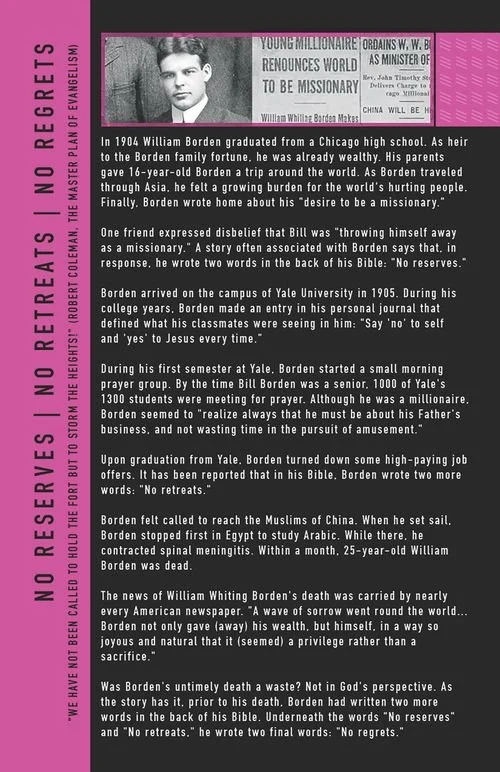
NO RESERVES, NO RETREATS, NO REGRETS

One of my heroes of the faith is the little-known missionary William Borden.

William Borden’s funeral took place at The Moody Church in Chicago.

During my college years, I discovered the beauty of the gospel while attending The Moody Church.

Here's something my team filmed a few years back on location.

3 PRINCIPLES I LEARNED WHILE AT THE WHITE HOUSE

In 2020 (one week before the world shut down because of COVID), I was invited to The White House for a Special Briefing for Leaders of Faith.

Here are 3 principles I learned while at The White House…

1. THE CHURCH SHOULD BE APOLITICAL

We’re a big tent -- we welcome everybody here!  That means we fight for our unity: no gossip, no griping, we just don’t have time for that:


"But the one who slanders you behind your back

proves that he’s a fool, never to be trusted. If you keep talking, it won’t be long

before you’re saying something really wrong.” (Proverbs 10:18-19)


"Words that bring delight pour from the lips of the godly,

but the words of the wicked are duplicitous.” (Proverbs 10:32)


"When you act with presumption,

convinced that you’re right,

don’t be surprised if you fall flat on your face!

But walking in humility helps you to make wise decisions.” (Proverbs 11:2)

I love our church because we’re in this together -- We follow God, we trust our spiritual leaders, and we roll up our sleeves to make a difference for time and eternity. 

We want to unite as many people as possible as quickly as possible under the Jesus Flag through our Midland and Saginaw Campuses.

A life lived loving God bears lasting fruit,

for the one who is truly wise wins souls.” (Proverbs 11:30)


Security at The White House was TIGHT -- Secret Service was everywhere!

I discovered that it is very hard to get access to the Most Powerful Person on Earth.

Not so with God -- We have 24/7 access with no K-9’s and no Secret Service!

2. WE HAVE INSTANT ACCESS TO THE MOST POWERFUL PERSON IN EXISTENCE


"The one who walks in integrity

will experience a fearless confidence in life.” (Proverbs 10:9)


Wow, aren’t those words great? 

Don’t we all just want a fearless confidence in our everyday life? 

Spending time with God fuels up our faith and trust in Him!


"Lovers of truth follow the right path

because of their wonderment and worship of God.” (Proverbs 14:2-4)


“The words of the wise

will become a shield of protection around them.

The only clean stable is an empty stable.

So if you want the work of an ox and to enjoy an abundant harvest,

you’ll have a mess or two to clean up!” (Proverbs 14)


God loves when we gather together -- We gather on Sundays because that’s the day Jesus rose. 

Sometimes we’re going to make messes together -- and that’s okay! 

Proverbs says that the only CLEAN stable is an EMPTY stable --- look around you, this place is not empty!

As we all fumble forward in our faith, let’s give each other a break… let’s show each other grace as we are all learning together what it looks like to follow Christ day by day.


"To worship God in wonder and awe

opens a fountain of life within you,

empowering you to escape death’s domain.” (Proverbs 14:27)

I went to a White House Briefing -- It was all “Off the Record” -- Y’know, sometimes it is Hard to get clear info from Politicians!


Book of Proverbs = God is crystal clear with wisdom that applies to everyone, everywhere!


3. GOD GIVES US WISE ADVICE WHENEVER WE LOOK FOR IT!


"Wisdom soothes the heart of the one with living-understanding,

but the heart of the fool just stockpiles stupidity.” (Proverbs 14:33)


The Bible has a term for the person who refuses wise counsel: “fool." (Prov 12:15)    

When we refuse to listen, when we dodge the truth, when we insist on having our own way, we are fools.

"The fear of the Lord is the beginning of wisdom." (Prov. 9:10) 


Wisdom begins with the recognition of who God is.
Wisdom begins when we recognize that God is God and then respond accordingly.

"Lovers of God hunger after truth,

but those without understanding

feast on foolishness and don’t even realize it.” (Proverbs 15:14)

"Go ahead and make all the plans you want,

but it’s the Lord who will ultimately direct your steps.

We are all in love with our own opinions,

convinced they’re correct.

But the Lord is in the midst of us,

testing and probing our every motive.

Before you do anything,

put your trust totally in God and not in yourself.

Then every plan you make will succeed.

The Lord works everything together to accomplish his purpose.” (Proverbs 16:1-5)