Remembering Gallagher

Like many in my generation, I discovered Gallagher comedy specials rerunning back-to-back on Old School VH1 weekends back in 1990.

Between his ridiculous roller skates, the microphone that literally hung around his neck, and bits of watermelon flying through the air via his “patented” Sledge-O-Matic, Gallagher provided an entry into stand-up comedy for this impressionable Gen Xer.

In high school, I somehow convinced my Mom to take me to my first Gallagher show at the Adler Theater in Davenport, Iowa. Before his stand-up show, the crowd was lined up to meet Gallagher in the lobby as he signed autographs.

Wearing my freshly-purchased Gallagher t-shirt, when I got to the front of the line, I asked him to sign my t-shirt. Gallagher instructed me to lay down on the table, whereupon the famous comedian straddled me and signed my chest!

Another time Gallagher returned to the same theater — it was the comedy tour where he revealed his head had been shaved. I’ll never forget that particular comedy set because he was making Superman jokes on the literal date that Superman Died (it was the Fall of 1992).

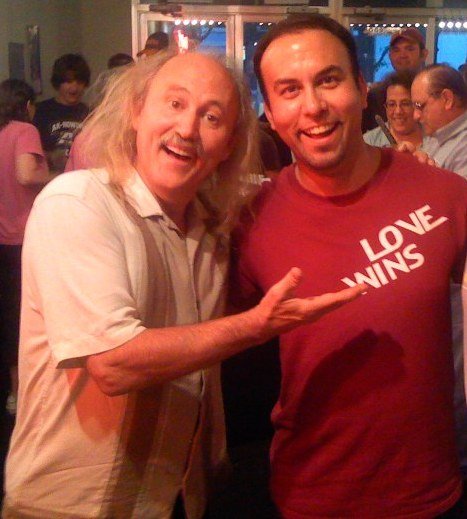
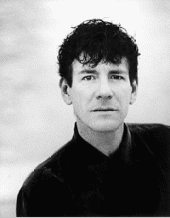
Several years later when I saw him live again in 2007 (pictured above), I relayed the t-shirt story to an older Gallagher. He said he didn’t remember that moment, but admitted it was definitely something he would do.

I’m going to miss Gallagher.

Have You Considered a Church Merger?

We Are Better Together

Church mergers have become one of the most effective strategies for struggling churches to thrive again, for growing churches to amplify their reach, and for church facilities to be better utilized to advance the Gospel in a region.

What is a Church Merger?

When two or more churches become one through the combining, integrating, and unifying of people, structures, systems, and resources in order to better reach their community with the message of Jesus.

Three Types of Church Mergers

  1. Rebirth
    Typically when a struggling church gets a second life by being restarted under a stronger, vibrant, usually larger church.

  2. Adoption
    This occurs when a stable or stuck church is integrated under the leadership of a stronger, vibrant, usually larger church.

  3. Marriage
    Typically when two growing churches realign with each other under a unified vision and new leadership configuration.

Questions to Consider

  1. Could we accomplish more together than we could separately? Would we find more ministry synergy, created by the two churches joining with common vision and purpose?

    2. Would my congregation benefit from this merger? Would my individual congregation be better, healthier or stronger by joining with this church?

    3. Would our community be better served by us working together?
    By joining forces, can we make a bigger impact in our surrounding community?

    4. Could the Kingdom of God be further extended by us joining together? Would uniting help us make more and better disciples of Jesus?


INTERESTED IN LEARNING MORE?  Let Us Know!

6 Steps to Relaunching Your Church

If we want our churches to grow and to reach more people for Christ, we have to learn to speak the same language.

Ask your team: Why does your church exist?

Everyone has a vision for your church, but you need to know why.

Vision & Values are required for your church to grow.

A program won't grow your church, but a process will.


  1. Engagement

    People are interested in spiritual things, but too often the church is answering questions that no one is asking.

    Discover what keeps your neighbors up at night (HINT: usually it’s something involving finances or relationships). Use their felt need to take them to their greatest need!

    In engagement comes explanation (see Nehemiah 8:1–10).

    Make it clear and give the meaning to the people.

  2. Excellence


    It's not about achieving perfection, it's about giving the best effort with what you have. Jesus has never given us anything but His absolute best!

    Excellence doesn't always mean spending more money, but it does mean expending greater effort.

  3. Excitement

    Listen, you need to become your church’s BIGGEST CHEERLEADER for EVERY Sunday!

    The devil is excited if you’re not excited about this coming Sunday!!

  4. Patience

    What a lot of churches call discipleship is nothing more than a form of control and manipulation. We cannot ‘microwave’ leaders!

    Thank about it: What would happen if the church responded to spiritual babies the way we respond to our children?


    We have to be patient with people.

    Discipleship is not a program, it's a process.

  5. Kindness

    What if the church was known because it was nice to people?

    Jesus was kind! People will come to Christ if we preach the biblical version instead of the denominational version of Jesus.

  6. Remembrance

    Don't ever forget what he's saved you from (2 Corinthians 1:26–31).

Fighting Your Fears Through Laughter

The late Dr. Martin de Maat had a profound impact on my life (I wrote about that here).


He was not only my professor and mentor, he was a close friend (Martin was even one of my wedding groomsmen!).

Dr. de Maat taught me so much not only about improvisational-comedy, but more importantly about the joy of doing life together:

"What happens... in
being with each other in acceptance and Yes And-ing each other, is that you as an individual start to believe in yourself because you begin to see yourself in the others' eyes.

Your ensemble, your group, your team, your committee, is the one that's believing in you and
you pull it together to do it for them.

You know, it's simply recognizing
you're not alone. It's love and unconditional acceptance.

You put yourself in a place of support, unconditional acceptance and love for who you are, the way you are and your uniqueness, and what you do is grow. You surround yourself with people who are truly interested in you and listen to you, and you will grow.

And it doesn't take much to start advancing you, it doesn't take much of that support, it doesn't take much of that love and that care and you can do it.
You can play act with people. You can be in a state of play together."


This is how comedians create new material.
Yes And leads to trust leads to contagious unity leads to childlike creativity.
It's how leaders might lead teams in the 21st Century.

Don't settle for the loneliness of leadership isolation.

Dream of and strive for a team of church leaders who are accepting of one another's uniquenesses. After all, we each bring different strengths to the table.

I love what Martin would say about the group dynamics of creating comedy through
Yes And:

"There's a lot of laughter that goes on. Since we're laughing together,
we're true community. It's a very safe place to confront your fears. The minute somebody says, 'Perform!' your fear comes up..."


As we
Yes And, may we as leaders embrace contagious unity and laughter.
By refusing to perform and instead choosing raw, authentic community, we may just lead at a higher, deeper, more spiritually-sensitive level than before...

The 3 Types of Church Start-Up Models

Based on chapter five of Planting Missional Churches,1 three different leadership models are presented for church planters: The Apostolic Harvest Church Planter, The Founding Pastor, and Team Planting. Each model offers different strengths and weaknesses, which will be briefly explored here.

The Apostolic Harvest Model occurs when a church planter starts a new church, raises up leaders from within (i.e. Paul and Timothy), and then moves on to begin a new church work. To be sure, this model was championed by Paul in the Book of Acts, as the Apostle would travel along the Mediterranean Rim in his efforts of spreading the Gospel through establishing new churches.2 The recording of Paul's words to the new Ephesian Elders gleans insight into the leadership hand-off of the church planter to indigenous leadership.3 This model excels at multiplying many churches since the main church planter is made available every few years for new church planting efforts. However, this model lends toward weakness if strong internal leadership is not properly trained or raised up in the church planter's absence.

The Founding Pastor Model involves a church planter starting a church initially, remaining as the entrepreneurial leader for the short-term before transitioning into a more long-term role as pastor of the new church. Examples of this model include Priscilla and Aquila,4 C.H. Spurgeon, and Rick Warren, the latter of which have influenced the majority of current North American church planters with this model. Strengths include stability for the newly-established congregation leading to long-term impact in their community. A weakness of this model could be the mission field "loss" of a church planter who neglects possible skills and giftings for future Kingdom expansion.

Finally, the Team-Planting Model is exemplified by a team of planters/pastors who relocate to a new area to begin a church plant. This model is rare in North America due to the financial cost and group buy-in required. Internationally, however, it is excelling: "Today, in cross-cultural mission, the team approach has become the norm for pioneer church planting. Often team members are all vocational missionaries, but this is not always the case; some may be bi-vocational."5

An indirect example of the Team-Planting Model in Scripture involves the church at Ephesus which had a number of formative leaders (Priscilla, Aquila,6 Paul,7 Apollos8), underscored by Paul's letter to Timothy to now lead the church at Ephesus: "To Timothy my true son in the faith... As I urged you when I went into Macedonia, stay there in Ephesus so that you may command certain people not to teach false doctrines any longer or to devote themselves to myths and endless genealogies."9

Strengths of this model include robust spiritual gifts being deployed into one new congregation, sharing the tasks and burdens of starting a new church from scratch. Weaknesses include, as mentioned before, the higher financial costs of employing multiple ministry workers at the onset of a new church plant.

While all models provide opportunities for advancing the Gospel, one finds himself most drawn toward the Founding Pastor Model, as it provides both creative flexibilities for the church planter while also allowing shepherding gifts to be utilized in caring for the new congregants and making a lasting impact for eternity. Due to this model's prevalence currently in the North American context, training and coaching is readily available for the Founding Pastor, better supporting the ministry efforts of the new church start-up.
____________


1 Stetzer, Ed and Daniel Im, Planting Missional Churches (Nashville, TN: B&H Academic, 2016).
2 Acts 16 (NIV)
3 Acts 20:22-35
4 Romans 16:3
5 Ott, Craig, and Gene Wilson. Global Church Planting: Biblical Principles and Best Practices for Multiplication (Grand Rapids, MI: Baker Academic, 2011).
6 Acts 18:18-19
7 Acts 18:24-25
8 Acts 19:1-21
9 1 Timothy 1:2-4

Life Church's Core Values

Values are important in any organization as they articulate the kind of organization we dream of becoming.

Putting into words the culture you are seeking to model into existence is hard work.

During my recent doctoral studies, I've been refreshing Life Church's Core Values for the journey ahead.

For what it's worth, here are our Core Values, Version 2.0...

We Are United Under One Vision


To reach the people no one else is reaching, we will do the things no one else is doing.
We will do anything short of sin to reach people far from God.
We will unapologetically and aggressively defend our unity and vision.

Every Person Matters


All people are image-bearers of God and are wonderfully made.
Because every person matters, relationships are not disposable.
We will always choose conversation over condemnation.
We will always seek to maintain the relationship over winning the argument.
We choose honesty over hypocrisy and gospel over gossip.

We Strive for Integrity, Transparency & Accountability


We do not gossip or spread rumors.  No insider politics here.
Full of honor and integrity, we will choose to do the right thing even when it hurts.
Our position is to out-love, out-serve, and out-give those who misunderstand us.

Because we have nothing to hide, we value humble transparency in all areas, including finances.

Everyone is accountable to someone at Life Church.

Found People Find People


We will put more effort into reaching the Lost than keeping the Found.
We will never allow this lifeboat to become a yacht club.
We will spare no expense because the just-one-more is worth it.
We will celebrate every story because every person matters.

Saved People Serve People


“... just as the Son of Man did not come to be served, but to serve..."  (Jesus in Matthew 20:28)

Becoming more like Jesus means we focus on serving others.
When we take the spotlight off ourselves and place it on other people, it will result in improving our marriages, making a difference in our workplaces and discovering our spiritual gifts.

We are never more like Christ than when we see Sunday mornings as our mission field.

Growing People Change


Jesus accepts us as we are, but He loves us too much to let us stay that way.
Over time, the Lord changes us from the inside out.

Colossians 3:9-10 reminds us that we have "taken off the old self" and "put on the new self."
Once we know Jesus, we can’t go back to the people we were before.

As we listen to Jesus and do what He says, our desires change.
We begin to think and act and love as He did.

I Cannot Out-Give God


“For God so loved the world that He gave His one and only Son, that whoever believes in Him shall not perish but have eternal life.”  (Jesus in John 3:16)

It is a spiritual impossibility for us to outgive God, because He has already given us everything.
Everything belongs to God and we are simply managers of God's stuff.
When we give, we’re giving God back a small portion of what He’s already given us.

Jesus is Our Only Celebrity


We celebrate the contributions of God's servants to our spiritual education and formation,
but we look to Jesus above all others and put our hope in Him alone.


Movements Move


We are not Atari, we are Apple.
We believe in humor over hammer.

We will always maintain a posture of humility and learning new methods for reaching people far from God.

We will always narrow the focus in all we do.  We think steps, not programs.